Emergency Funds Explained: How Much You Need in the UK (2026)
 By Matthew Harman — Matthew has been navigating UK personal finance for over 30 years, from first mortgages to ISA strategies, and founded BudgetSense to share what actually works.
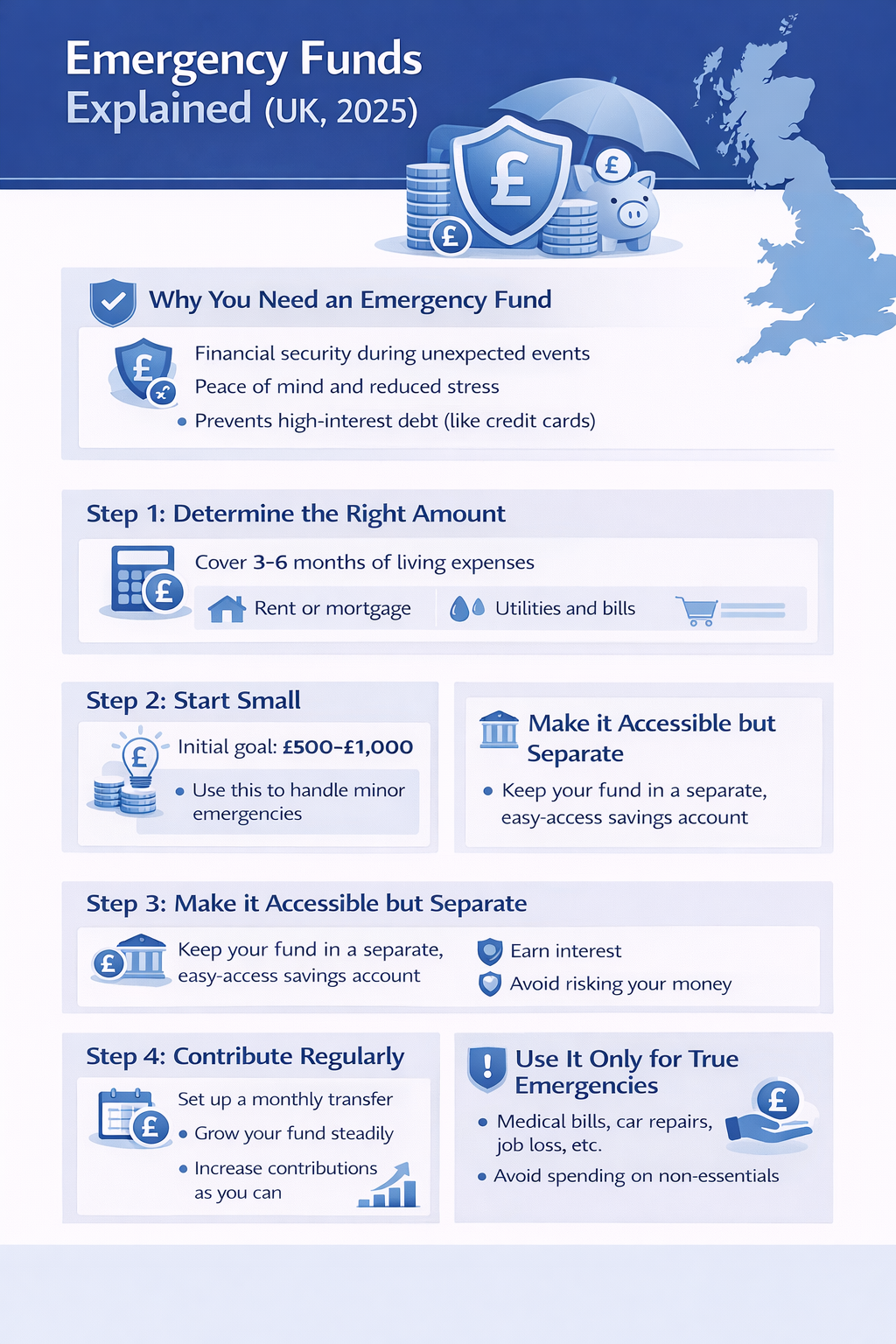
Visual summary of key points from 'Emergency Funds Explained: How Much You Need in the UK (2026)'
Essential UK Budgeting & Personal Finance Guides for 2026
Discover practical tips, tools, and strategies to manage your money, save effectively, and stay on top of your finances.
Check out our key articles: How to Create a Simple Budget, How to Save £500 in 3 Months, Understanding Credit Scores in the UK.
Emergency Funds Explained: How Much You Need in the UK (2026)
An emergency fund is money set aside specifically for unexpected expenses — a boiler breakdown, sudden job loss, car repair, or urgent dental bill. It sits separate from your regular savings and exists for one purpose: to stop an unexpected cost turning into a debt problem.
Without one, most people reach for a credit card or overdraft when something goes wrong. With one, you handle the same situation without paying interest or derailing your finances. It is one of the most straightforward and high-impact things you can do for your financial stability.
How much should you save in an emergency fund?
The standard recommendation is three to six months' worth of essential expenses — not your total income, just the non-negotiable outgoings you must cover every month. For most UK households that means:
- Rent or mortgage
- Council tax
- Energy, water, and broadband bills
- Food and essential groceries
- Essential transport (car insurance, fuel, or travel pass)
- Minimum debt repayments
- Childcare if applicable
Add those up and multiply by three for the lower end of your target, six for the upper end.
| Monthly essentials | 3-month target | 6-month target |
|---|---|---|
| £1,000 | £3,000 | £6,000 |
| £1,500 | £4,500 | £9,000 |
| £2,000 | £6,000 | £12,000 |
| £2,500 | £7,500 | £15,000 |
Three months is a reasonable target for most people. Six months is worth aiming for if you are self-employed, work on a contract basis, or have dependants relying on your income.
Start with a starter fund of £1,000
If three to six months feels overwhelming, don't let that stop you starting. A starter fund of £500 to £1,000 handles the vast majority of everyday emergencies — a car repair, a washing machine breaking down, an unexpected bill. It is far more useful than nothing and gives you breathing room while you build toward the fuller target.
Once you have £1,000 set aside, shift your focus to clearing high-interest debt if you have any, then come back and build the fund to the full three-month level.
Where to keep your emergency fund in the UK
Your emergency fund needs to be in a place that is safe, accessible within a day or two, and separate enough from your current account that you won't dip into it casually. The right account type is an easy-access savings account.
In 2026, easy-access savings rates in the UK are meaningfully higher than they were a few years ago. There is no reason to leave an emergency fund sitting in a current account earning nothing when you can earn 4–5% in an easy-access account with the same level of accessibility.
- Easy-access savings accounts — money available within one to two working days, competitive interest rates, no lock-in. Best for most people.
- Cash ISA (easy access) — same accessibility but interest is tax-free. Worth using if you are a higher-rate taxpayer or already using your Personal Savings Allowance.
- Do not use a fixed-term bond or notice account — the whole point of an emergency fund is instant access. Locking it away defeats the purpose.
- Do not invest it — stock market values fluctuate. Your emergency fund needs to be worth the same on the day you need it as it is today.
For the best current easy-access rates, see our guide to best high-interest savings accounts in the UK.
How to build your emergency fund
Step 1 — Calculate your target
Work out your monthly essential expenses using the list above. Multiply by three to get your initial target. Write it down as a specific number — "£4,500 by December 2026" is far more motivating than "3 months of expenses."
Step 2 — Open a separate account
Open a dedicated easy-access savings account and name it "Emergency Fund" if your bank allows it. Keeping it separate from your current account removes the temptation to spend it and makes it easy to track progress.
Step 3 — Automate a monthly contribution
Set up a standing order to transfer a fixed amount on payday — before you have a chance to spend it. Even £50 a month builds to £600 in a year. £150 a month reaches £1,800. The exact amount matters less than the consistency.
| Monthly contribution | After 6 months | After 12 months | After 24 months |
|---|---|---|---|
| £50 | £300 | £600 | £1,200 |
| £100 | £600 | £1,200 | £2,400 |
| £150 | £900 | £1,800 | £3,600 |
| £200 | £1,200 | £2,400 | £4,800 |
Step 4 — Boost it with windfalls
Any unexpected money — a tax refund, a work bonus, a gift — is a natural opportunity to accelerate your emergency fund. Even putting half of an unexpected windfall into the fund while spending the other half guilt-free keeps progress moving without feeling restrictive.
Step 5 — Rebuild it after use
When you do use the fund — which is exactly what it is there for — treat rebuilding it as your immediate next financial priority. Resume your standing order and redirect any spare cash until it is back to target.
What counts as a genuine emergency?
This is where discipline matters. The fund exists for unplanned, necessary expenses — not for things you could have anticipated or saved for separately. A useful test: ask yourself whether the expense was genuinely unexpected and whether it is something you must deal with now.
Things that qualify:
- Boiler or essential appliance breakdown
- Urgent car repair you need to get to work
- Sudden job loss or reduction in income
- Unexpected medical or dental costs
- Emergency travel (family illness, bereavement)
Things that do not qualify:
- Holidays or planned events
- Christmas or birthday gifts — these are predictable and should be budgeted separately
- A sale on something you wanted to buy anyway
- Non-urgent home improvements
Emergency fund vs paying off debt — what comes first?
This is one of the most common questions and there is no single right answer, but a practical approach that works for most people:
- Build a starter fund of £500–£1,000 first — this covers small emergencies so you don't add to debt when something goes wrong
- Clear high-interest debt (credit cards, overdrafts) aggressively while maintaining minimum payments on everything else
- Once high-interest debt is cleared, build the emergency fund to three months
- Continue to six months if your income is variable or you have dependants
The logic: if you have credit card debt at 20% APR and your savings account pays 5%, every pound sitting in savings is effectively costing you 15%. Clearing the debt first is mathematically better — but only once you have a small buffer to avoid new debt when something unexpected happens.
Frequently asked questions
- How quickly should I build my emergency fund? Build the initial £1,000 as fast as possible — ideally within three to six months. The full three-to-six month fund can be built steadily over one to two years alongside other financial goals.
- Should my emergency fund be in a Cash ISA or savings account? Either works well. A Cash ISA is better if you are a higher-rate taxpayer or have used your £1,000 Personal Savings Allowance. Otherwise a high-interest easy-access account is simpler and often pays a similar rate.
- What if I'm self-employed? Aim for six months rather than three. Irregular income makes the fund more important, not less. Some self-employed people keep a separate pot for tax bills on top of their emergency fund.
- Can I invest my emergency fund for better returns? No. Investments can lose value — your emergency fund must be worth its full amount on the day you need it. Keep it in cash in an easy-access account.
- Is £1,000 enough? As a starting point, yes. It covers most common household emergencies. Build beyond it once you have cleared high-interest debt.