Investing for Beginners UK (2026): Where to Start With Any Budget
 By Matthew Harman — Matthew has been navigating UK personal finance for over 30 years, from first mortgages to ISA strategies, and founded BudgetSense to share what actually works.
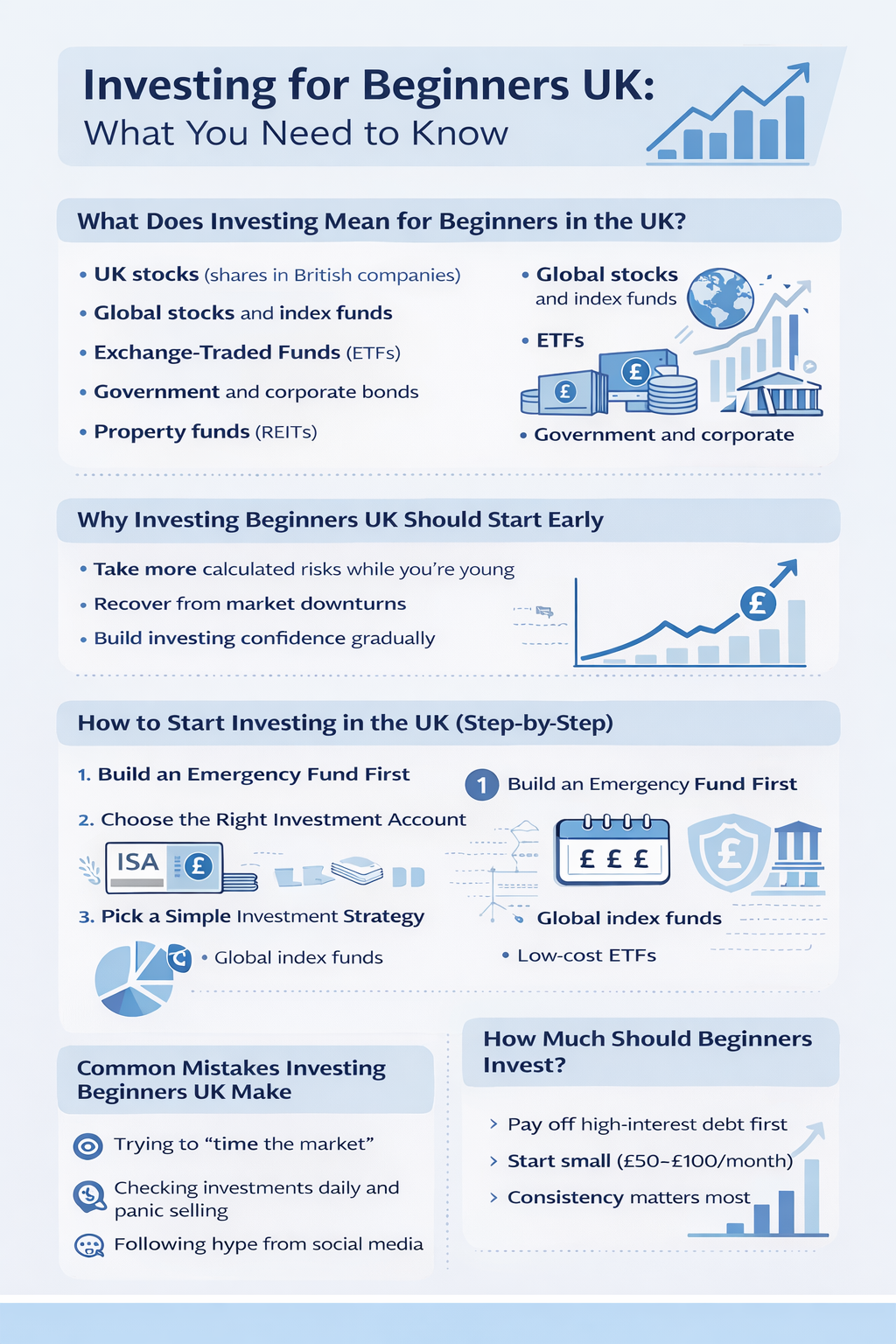
Visual summary of key points from 'Investing for Beginners UK (2026): Where to Start With Any Budget'
Essential UK Budgeting & Personal Finance Guides for 2026
Discover practical tips, tools, and strategies to manage your money, save effectively, and stay on top of your finances.
Check out our key articles: How to Create a Simple Budget, How to Save £500 in 3 Months, Understanding Credit Scores in the UK.
Investing for Beginners UK (2026): Where to Start With Any Budget
Most people in the UK know they should be investing but are not sure where to begin. The terminology is confusing, the options feel overwhelming, and the fear of losing money keeps many people in cash savings accounts that are quietly losing value to inflation.
This guide cuts through the noise. It covers exactly what you need to know to start investing in the UK in 2026 — which accounts to use, what to invest in, how much you need, and the most common mistakes to avoid. No jargon, no assumptions about prior knowledge.
Important: All investing carries risk. The value of investments can go down as well as up and you may get back less than you invest. This guide is for informational purposes only and does not constitute regulated financial advice.
Before you invest: two things to sort first
Investing is not the right first step for everyone. Before putting money into stocks or funds, two things should be in place:
- An emergency fund. You need at least one to three months of essential expenses in an easy-access savings account before you invest. If something unexpected happens and you have no buffer, you may be forced to sell investments at a loss to cover costs. See our emergency fund guide for how much to save and where to keep it.
- No high-interest debt. If you have credit card balances or overdrafts at 20–40% APR, paying those down produces a guaranteed return equivalent to the interest rate — which almost always beats investing returns. Clear high-interest debt first, then invest.
If both boxes are ticked, you are ready to start.
Why time in the market beats timing the market
The most powerful force in investing is compound growth — the process by which returns generate their own returns over time. The longer your money is invested, the more dramatic this effect becomes.
| Monthly investment | After 10 years (7% avg return) | After 20 years | After 30 years |
|---|---|---|---|
| £50/month | £8,654 | £26,070 | £60,731 |
| £100/month | £17,308 | £52,141 | £121,462 |
| £200/month | £34,617 | £104,282 | £242,924 |
| £500/month | £86,542 | £260,706 | £607,310 |
These figures assume a 7% average annual return (roughly the long-term historical average for a globally diversified stock portfolio after inflation) and are for illustrative purposes only. Returns are not guaranteed and will vary.
The key point: starting with £50 a month at 25 is significantly more valuable than starting with £500 a month at 45. Time is the ingredient money cannot buy back.
Step 1 — Choose the right account type
In the UK, where you hold your investments matters as much as what you invest in. Using the wrong account type can mean paying unnecessary tax on your gains.
| Account type | Annual allowance | Tax treatment | Best for |
|---|---|---|---|
| Stocks & Shares ISA | £20,000 | No tax on gains or dividends | Most beginners — simple and flexible |
| Lifetime ISA (LISA) | £4,000 (counts toward ISA allowance) | 25% government bonus + tax-free growth | First home buyers or retirement (under 40 only) |
| SIPP (pension) | Up to £60,000 or 100% of earnings | Tax relief on contributions + tax-free growth | Retirement investing, especially higher-rate taxpayers |
| General Investment Account (GIA) | No limit | Capital gains and dividend tax apply above allowances | Investing beyond ISA allowance |
For most beginners, the Stocks and Shares ISA is the right starting point. You can invest up to £20,000 per tax year and pay no tax on any gains or income, ever. It is also flexible — you can withdraw money when you need it without penalty (unlike a pension).
If you are under 40 and saving for a first home, the Lifetime ISA adds a 25% government bonus on top of your contributions (up to £1,000 free per year) — which is an exceptional return before any investment growth.
Step 2 — Choose a platform
Your investment platform is where you open your ISA or pension and buy investments. Platform fees vary significantly and have a major impact on long-term returns. For a detailed comparison, see our guide to best cheap UK investment platforms 2026.
As a quick guide for beginners:
| Platform | Platform fee | Best for | Minimum investment |
|---|---|---|---|
| Trading 212 | None | Complete beginners, £1 minimum | £1 |
| InvestEngine | None | ETF-only passive investors | £100 |
| Vanguard | 0.15%/year | Long-term index fund investors | £500 or £100/month |
| Freetrade | £60/year | Active investors on a budget | £2 |
| AJ Bell | 0.25%/year | Wider asset range | £500 or £25/month |
All platforms listed are FCA-regulated. Your investments are protected under the Financial Services Compensation Scheme (FSCS) up to £85,000.
Step 3 — Decide what to invest in
For most UK beginners, the answer is simple: a low-cost, globally diversified index fund or ETF. This single choice removes the need to pick individual stocks, times the market, or research individual companies.
What is an index fund?
An index fund tracks a market index — such as the FTSE 100 (the 100 largest UK companies) or the FTSE All-World (thousands of companies across the globe). Instead of trying to beat the market, it simply matches it. The evidence consistently shows that index funds outperform most actively managed funds over the long term, after fees.
What is an ETF?
An Exchange-Traded Fund (ETF) works like an index fund but trades on a stock exchange like a share. For practical purposes, index funds and ETFs are interchangeable for most beginners. Both offer instant diversification at very low cost.
Good starting options for UK beginners
- Vanguard FTSE All-World ETF (VWRL) — tracks thousands of companies across developed and emerging markets globally. One of the most popular beginner choices in the UK.
- Vanguard FTSE Global All Cap Index Fund — similar global coverage, available as a fund rather than an ETF. Available directly through Vanguard.
- iShares Core MSCI World ETF (SWDA) — tracks developed market companies globally. Slightly narrower than VWRL but lower ongoing charge.
All three give you exposure to hundreds or thousands of companies worldwide through a single, low-cost investment. Ongoing charges are typically 0.10–0.25% per year.
If you prefer even lower risk to start with, see our guide to 5 low-risk investments UK beginners can try.
Step 4 — Set up a regular monthly contribution
The most effective investing habit is a monthly direct debit or standing order into your investment account — ideally set to invest automatically into your chosen fund on the same day each month.
This approach, called pound-cost averaging, means you buy more units when prices are low and fewer when prices are high — smoothing out the effect of market volatility over time. It also removes the temptation to time the market, which consistently underperforms simply staying invested.
Start with whatever you can afford consistently. £25, £50, or £100 a month — the amount matters far less than the habit. Increase it when your income allows.
Common mistakes beginners make
- Trying to pick individual stocks. Most professional fund managers fail to beat the market consistently. Individual stock picking as a beginner is speculation, not investing.
- Checking the portfolio daily. Short-term market movements are noise. Checking daily creates anxiety and increases the temptation to sell at the wrong moment.
- Panic selling during downturns. Every significant market drop in history has eventually been followed by recovery and new highs. Selling during a downturn locks in a loss that would otherwise have been temporary.
- Investing money you might need within five years. Investments need time to recover from downturns. Money you might need within five years should stay in savings, not investments.
- Ignoring fees. A 1% annual fee difference compounds significantly over 20–30 years. Choosing a platform charging 0.15% versus 0.45% on a £50,000 portfolio saves tens of thousands over a lifetime.
- Following social media tips. Reddit, TikTok, and YouTube investment tips are entertainment, not financial advice. Most viral stock tips arrive after the gains have already been made.
UK tax rules beginners need to know
- ISA allowance: £20,000 per tax year (6 April to 5 April). Gains and income inside an ISA are completely tax-free.
- Capital Gains Tax (CGT) allowance: £3,000 per year (2024/25 and 2025/26) for gains outside an ISA. Above this, gains are taxed at 18% (basic rate) or 24% (higher rate) on investments.
- Dividend allowance: £500 per year (2024/25 onwards) outside an ISA. Dividends above this are taxed at your marginal rate.
- Pension tax relief: Contributions to a SIPP receive tax relief at your marginal rate — a basic rate taxpayer effectively gets 25% free money added by HMRC on every contribution.
For most beginners investing within their £20,000 ISA allowance, tax is not a concern. The ISA wrapper handles it entirely.
Frequently asked questions
- How much money do I need to start investing in the UK? Some platforms allow you to start with as little as £1 (Trading 212). Most beginners start with £25–£100 per month. The amount matters far less than starting and staying consistent.
- Is investing in the stock market safe? No investment is completely safe — all investing carries risk of loss. However, a globally diversified index fund held for 10+ years has historically produced positive returns in every significant market in history. Risk reduces substantially with time and diversification.
- What is the best investment for a UK beginner? A low-cost global index fund or ETF held inside a Stocks and Shares ISA is the most consistently recommended starting point. The Vanguard FTSE All-World ETF (VWRL) is one of the most widely used beginner investments in the UK.
- Should I invest or pay off my mortgage? Generally, invest if your mortgage rate is below 4–5% and expected investment returns exceed the mortgage rate over the long term. At higher mortgage rates, overpaying may be more beneficial. This is a personal decision — consider speaking to a financial adviser for your specific situation.
- Can I lose all my money investing in an index fund? In theory, yes — but in practice, a global index fund would only go to zero if every major company in the world simultaneously collapsed. This has never happened and would represent a complete breakdown of the global economy. Individual company stocks carry a much higher risk of total loss.