UK Pension Planning Explained (2026): How Much to Save & Where to Start
 By Matthew Harman — Matthew has been navigating UK personal finance for over 30 years, from first mortgages to ISA strategies, and founded BudgetSense to share what actually works.
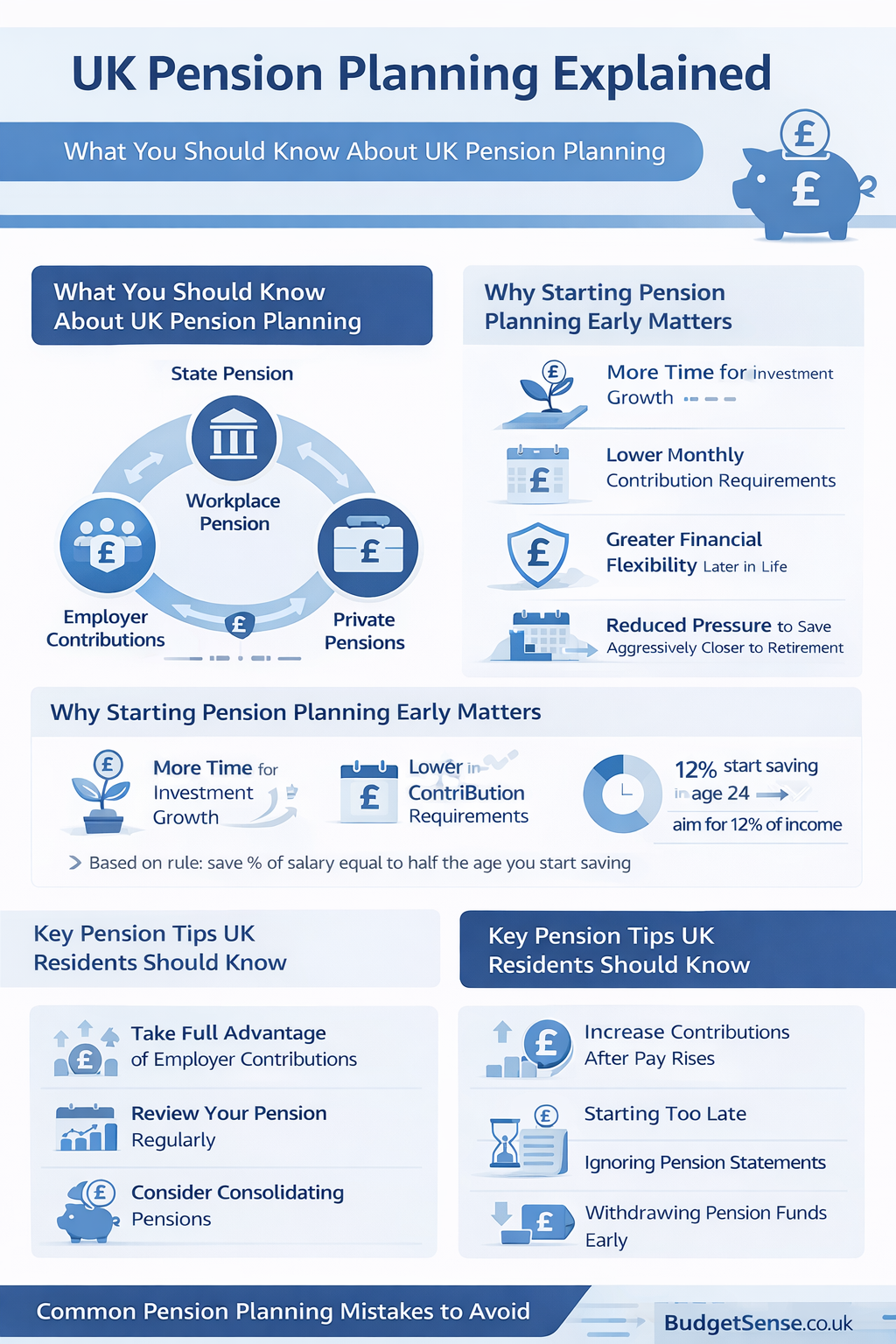
Visual summary of key points from 'UK Pension Planning Explained (2026): How Much to Save & Where to Start'
Essential UK Budgeting & Personal Finance Guides for 2026
Discover practical tips, tools, and strategies to manage your money, save effectively, and stay on top of your finances.
Check out our key articles: How to Create a Simple Budget, How to Save £500 in 3 Months, Understanding Credit Scores in the UK.
UK Pension Planning Explained (2026): How Much to Save & Where to Start
Most people in the UK know they should be saving for retirement but are unclear on the specifics — how much is enough, which type of pension to use, how tax relief works, and whether the State Pension alone will cover their needs. This guide answers all of those questions with the actual 2026 figures.
Important: This article is for informational purposes only and does not constitute regulated financial advice. Pension decisions can be complex — consider speaking to a regulated financial adviser for personalised guidance.
The three pillars of UK retirement income
Most UK retirees draw income from some combination of three sources. Understanding how each one works is the starting point for any retirement plan.
| Source | Who it's for | 2026 amount / details | Action required |
|---|---|---|---|
| State Pension | Everyone with sufficient NI contributions | £221.20/week (full new State Pension, 2025/26) | Check your NI record at gov.uk |
| Workplace pension | Employed workers (auto-enrolled) | Minimum 8% total (3% employer + 5% employee) | Ensure you are enrolled and contributing |
| Private pension / SIPP | Anyone — especially self-employed | Up to £60,000/year with tax relief | Open a SIPP if self-employed or want to top up |
The State Pension in 2026
The full new State Pension is £221.20 per week (£11,502 per year) for 2025/26, rising each April in line with the triple lock — whichever is highest out of earnings growth, inflation (CPI), or 2.5%.
To receive the full amount you need 35 qualifying years of National Insurance contributions. You need a minimum of 10 qualifying years to receive anything at all. You can check your State Pension forecast and NI record for free at gov.uk/check-state-pension.
The State Pension age is currently 66 for both men and women, rising to 67 between 2026 and 2028, and planned to rise to 68 in the mid-2040s.
The honest reality: £221.20 a week (£11,502 a year) is below the minimum income standard for a single person in the UK, which the Joseph Rowntree Foundation estimates at around £14,400 a year. Most people will need additional pension income to maintain a reasonable standard of living in retirement.
Workplace pensions and auto-enrolment
If you are employed and earn above £10,000 a year, your employer is legally required to automatically enrol you into a workplace pension. Current minimum contribution rates are:
| Contributor | Minimum contribution | On what earnings |
|---|---|---|
| Employee | 5% (includes tax relief) | Qualifying earnings (£6,240–£50,270 in 2025/26) |
| Employer | 3% | Qualifying earnings |
| Total | 8% | Qualifying earnings |
These are minimums — many employers offer higher contributions, particularly if you increase your own contribution above the minimum. Always contribute at least enough to receive your full employer match. If your employer matches up to 5% and you only contribute 3%, you are leaving free money behind.
Common UK workplace pension providers
Most workplace pensions are managed by one of a handful of large providers — Nest (the government-backed scheme), The People's Pension, Aviva, Legal & General, and NOW: Pensions. Your employer chooses the provider; your job is to ensure you are enrolled, check your contribution level, and review your investment fund choice (most default funds are reasonable but not always optimal for your age).
SIPPs — for self-employed people and higher contributions
A Self-Invested Personal Pension (SIPP) is the main pension option for self-employed people and for employed people who want to save beyond their workplace pension. You choose your own investments within the SIPP — typically index funds or ETFs — and HMRC adds tax relief on top of your contributions.
- Annual allowance: Up to £60,000 per year (or 100% of your earnings if lower) with tax relief
- Tax relief: Basic rate taxpayers get 20% relief automatically — a £800 contribution costs you £800 but £1,000 goes into the pension. Higher rate taxpayers can claim additional relief through Self Assessment.
- Minimum age to access: Currently 55, rising to 57 in 2028
- Investment choice: Full control — most people use low-cost global index funds
Good low-cost SIPP providers in 2026 include Vanguard (0.15% platform fee, own funds only), InvestEngine (free, ETFs only), and AJ Bell (0.25%, wide range). For a full comparison see our guide to best cheap UK investment platforms 2026.
How much do you actually need to retire in the UK?
The Pensions and Lifetime Savings Association (PLSA) publishes annual Retirement Living Standards that give a concrete benchmark for how much income different retirement lifestyles require:
| Lifestyle | Single person (annual) | Couple (annual) | What it covers |
|---|---|---|---|
| Minimum | £14,400 | £22,400 | Basic needs covered, limited social activity |
| Moderate | £31,300 | £43,100 | More financial security, some leisure, one holiday/year |
| Comfortable | £43,100 | £59,000 | Regular holidays, car replacement, financial gifts to family |
The State Pension covers £11,502 of those figures. The gap — particularly for a moderate or comfortable lifestyle — needs to come from workplace and private pensions.
How much should you contribute?
A widely used rule of thumb: save a percentage of your salary equal to half the age you start saving.
| Age you start saving | Suggested total contribution | Includes employer + tax relief |
|---|---|---|
| 25 | 12.5% of salary | Yes — so employee portion is lower |
| 30 | 15% of salary | Yes |
| 35 | 17.5% of salary | Yes |
| 40 | 20% of salary | Yes |
| 45 | 22.5% of salary | Yes |
These are guidelines, not guarantees. The actual amount you need depends on your target retirement income, expected retirement age, State Pension entitlement, and investment returns. The key principle is that starting earlier makes the target significantly more achievable — and the minimum 8% auto-enrolment rate is not enough for most people who want a moderate or comfortable retirement.
The impact of compound growth on pension savings
The most powerful argument for starting pension contributions early is compound growth — investment returns generating their own returns over time. The difference between starting at 25 versus 35 is dramatic:
| Monthly contribution | Starting age | Pot at 67 (7% avg return) |
|---|---|---|
| £200/month | 25 | ~£525,000 |
| £200/month | 35 | ~£243,000 |
| £200/month | 45 | ~£101,000 |
| £400/month | 45 | ~£202,000 |
Starting at 35 instead of 25 roughly halves the pot at retirement for the same monthly contribution. Starting at 45 requires double the monthly contribution to achieve the same result as starting at 35. These figures assume 7% average annual growth (roughly the long-term historical average for a globally diversified portfolio) and are illustrative — returns are not guaranteed.
Pension tax relief — how it works in practice
Tax relief is one of the most valuable features of pensions. Every pension contribution is topped up by HMRC:
- Basic rate taxpayers (20%): For every £800 you contribute, HMRC adds £200 — making £1,000 in your pension. The tax relief is added automatically for most pension types.
- Higher rate taxpayers (40%): You can claim an additional 20% through Self Assessment — so a £1,000 pension contribution effectively costs you £600 after tax relief.
- Additional rate taxpayers (45%): Effective cost of a £1,000 contribution is just £550 after claiming full relief.
This makes pension contributions one of the most tax-efficient ways to save, particularly for higher earners. A higher-rate taxpayer contributing £1,000 gross per month to a SIPP is effectively only spending £600 of their take-home pay to do so.
Key pension mistakes to avoid
- Not checking your State Pension record. Gaps in your NI record can be filled voluntarily. A single year's voluntary NI contribution (around £824 in 2025/26) can add approximately £328/year to your State Pension for life — an exceptional return. Check and fill gaps at gov.uk/check-state-pension.
- Only contributing the auto-enrolment minimum. The 8% minimum is a floor, not a target. Most financial planners suggest 12–15% total for a moderate retirement.
- Leaving old workplace pensions scattered. The average UK worker has 11 jobs in their lifetime. Each may leave behind a small pension pot. Track down lost pensions using the government's Pension Tracing Service at gov.uk/find-pension-contact-details.
- Ignoring your investment fund choice. Most auto-enrolment schemes default to a "lifestyling" fund that gradually shifts to bonds as you approach retirement. This is reasonable but not always optimal — review it against your actual retirement timeline.
- Accessing pension early without understanding the costs. Withdrawing from a pension before age 55 (57 from 2028) typically triggers a 55% tax charge unless you are seriously ill. Taking large lump sums can push you into higher tax brackets. Take advice before accessing any pension funds.
Pensions and the self-employed
Self-employed people are not automatically enrolled in any pension scheme, which means pension saving requires deliberate action. The options are a SIPP or a stakeholder pension — both receive tax relief and work in the same way as employed pension contributions.
The challenge for the self-employed is irregular income. A practical approach: set aside a fixed percentage of every invoice payment into a pension rather than a fixed monthly amount. Even 10–15% of net income invested consistently through a low-cost SIPP can build a substantial retirement fund over time.
Self-employed people should also be aware that Class 2 and Class 4 National Insurance contributions count toward the State Pension — ensuring you are registered and paying the correct NI class is important for your eventual State Pension entitlement.
Frequently asked questions
- How much State Pension will I get in 2026? The full new State Pension is £221.20 per week (£11,502 per year) for 2025/26. You need 35 qualifying years of National Insurance contributions to receive the full amount. Check your personal forecast at gov.uk/check-state-pension.
- What is the pension annual allowance for 2026? The annual allowance is £60,000 per year (or 100% of your earnings if lower). This is the maximum you can contribute to all pensions combined with tax relief in a single tax year.
- Can I have both a workplace pension and a SIPP? Yes. Many people contribute to both — a workplace pension to capture employer contributions, and a SIPP for additional savings or to invest in a wider range of funds.
- When can I access my pension in the UK? The minimum pension access age is currently 55, rising to 57 in April 2028. You can take up to 25% of your pension pot as a tax-free lump sum, with the remainder taxed as income when withdrawn.
- Is it too late to start a pension at 50? No. Even starting at 50, consistent contributions with tax relief and investment growth can meaningfully improve your retirement income. The annual allowance of £60,000 allows for significant catch-up contributions if you have the income to support it.