Protected Pension Age Explained: The 55 to 57 Rule Change (2026 Guide)
 By Matthew Harman — Matthew has been navigating UK personal finance for over 30 years, from first mortgages to ISA strategies, and founded BudgetSense to share what actually works.
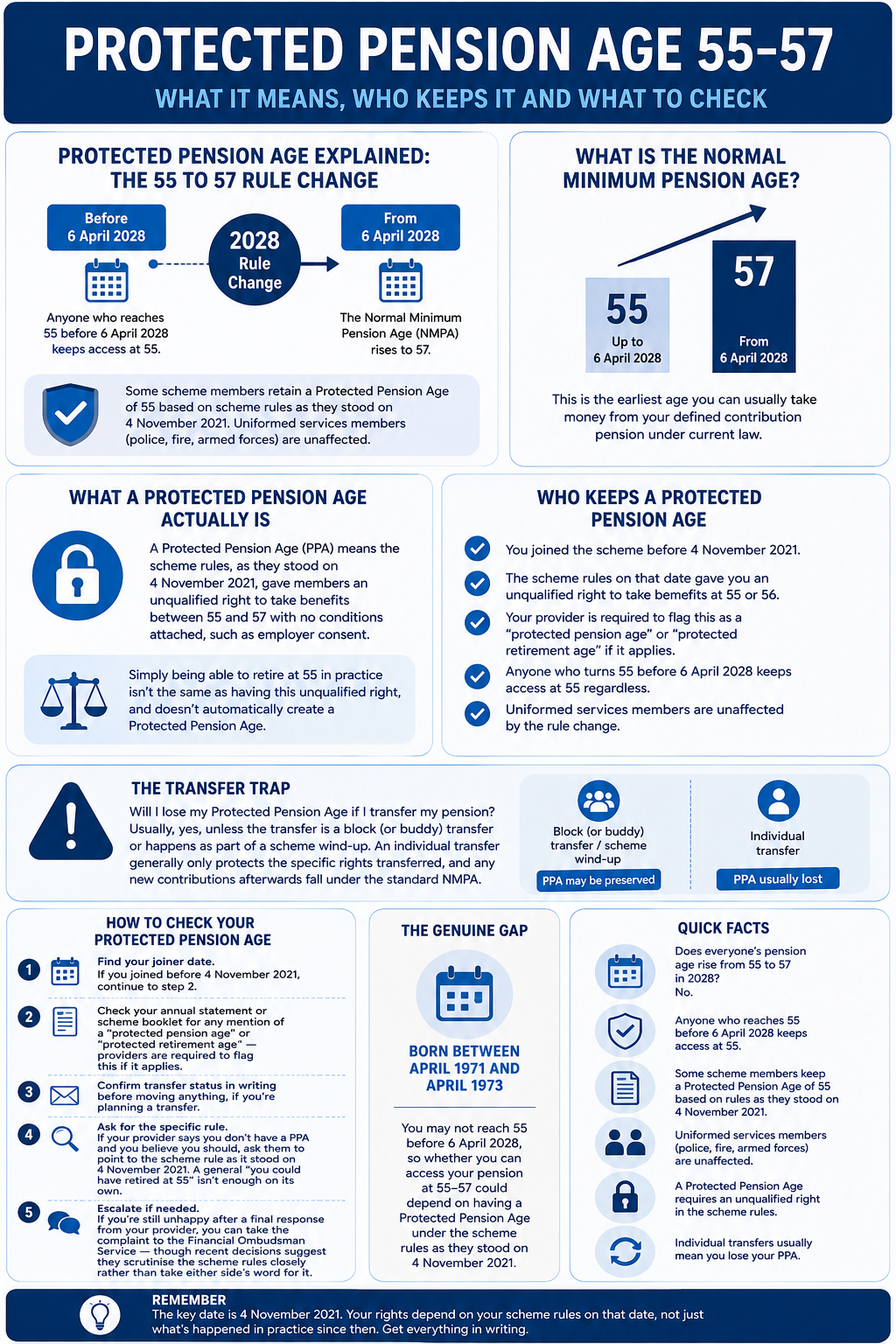
Visual summary of key points from 'Protected Pension Age Explained: The 55 to 57 Rule Change (2026 Guide)'
Essential UK Budgeting & Personal Finance Guides for 2026
Discover practical tips, tools, and strategies to manage your money, save effectively, and stay on top of your finances.
Check out our key articles: How to Create a Simple Budget, How to Save £500 in 3 Months, Understanding Credit Scores in the UK.
Protected Pension Age Explained: The 55 to 57 Rule Change
From 6 April 2028, the earliest age most people can access their private pension rises from 55 to 57. Some savers are protected from this change and can still access their pension at 55. Others assume they're protected and aren't. And a smaller group face a genuine gap in the legislation that could lock them out of their own pension for up to two years.
Important: This article is for informational purposes only and does not constitute regulated financial advice. If you're unsure how the change affects your specific pension, speak to your provider or a regulated financial adviser.
What is the Normal Minimum Pension Age?
The Normal Minimum Pension Age (NMPA) is the earliest age you can normally start drawing money from a personal or workplace pension without a doctor confirming you're seriously ill. It's currently 55. From 6 April 2028, it rises to 57.
The change happens overnight rather than being phased in. If you turn 55 on 5 April 2028, you can access your pension as normal. If you turn 55 the day after, on 6 April 2028, you'll generally need to wait until you're 57.
What a Protected Pension Age actually is
A Protected Pension Age (PPA) is a right, tied to a specific pension arrangement, that lets you carry on taking benefits from age 55 even after the general minimum rises to 57. It isn't something you apply for. You either have it because of how your scheme was set up, or you don't.
The main route to a PPA of 55 is having had an "unqualified right" under your scheme rules, as they stood on 4 November 2021, to take your pension between ages 55 and 57. That date matters more than your age, your job, or when you joined the scheme.
What "unqualified right" means in practice
This is where most confusion, and most Financial Ombudsman complaints, come from. Being able to retire at 55 isn't the same as having an unqualified right to do so. The Ombudsman has already ruled on this distinction in cases where savers assumed a PPA existed because they'd previously taken benefits early without needing anyone's sign-off.
The test looks at what the scheme's own rules said on 4 November 2021, not at what actually happened to any individual member. If the rules made early access conditional — on employer consent, for example, or on redundancy — that's a qualified right, and it doesn't carry a PPA. If the rules gave members an outright entitlement to draw benefits from 55 with no conditions attached, that's unqualified, and the PPA usually survives.
In two recent Ombudsman decisions, providers who told members they didn't qualify for a PPA of 55 were upheld. The members had assumed protection existed because they could have retired at 55 if they'd chosen to. The Ombudsman found that "could" isn't "unqualified right," and sided with the provider both times.
Who keeps a Protected Pension Age
| Group | Protection |
|---|---|
| Unqualified right at 55/56 under scheme rules on 4 Nov 2021 | Keeps PPA of 55 (or 56) |
| Uniformed services (police, fire, armed forces) | Not affected by the 2028 change at all |
| Existing 2006 protection of 55 or lower (from the 50→55 change in 2010) | Generally retained |
| Certain occupations with recognised early retirement pre-2006 | May retain lower protected ages |
| Anyone reaching 55 before 6 April 2028 | Can access pension at 55, protection or not |
The transfer trap
A Protected Pension Age is attached to the specific pot, not to you as a person. If you transfer your pension to a new provider, you usually lose the protection on that money — unless it's a "block" (or "buddy") transfer, where a group of members move together, or the transfer happens as part of a scheme wind-up.
This creates an awkward practical problem: if you transfer only part of your pension, or add new contributions to a protected pot after transferring in from elsewhere, you can end up with different slices of the same pension pot subject to different access ages. The protected portion stays accessible at 55; everything transferred in or contributed afterwards falls under the new NMPA of 57.
If keeping your Protected Pension Age matters to you, check with your existing provider before you transfer, not after. Ask specifically whether the transfer will be treated as a block transfer, and get the answer in writing.
The genuine gap: born between April 1971 and April 1973
Separate from the PPA question, there's a real design flaw in how the 2028 change was legislated — and it isn't down to any provider getting something wrong.
Because the rise from 55 to 57 happens overnight with no transitional taper, anyone who turns 55 after 6 April 2026 but hasn't yet turned 57 by 6 April 2028 faces a gap. In principle, someone born on 5 April 1973 could access their pension for a single day at 55 and then find it locked again until their 57th birthday in 2030. Former pensions minister Steve Webb has warned this could affect over a million people, and as things stand there's no transitional relief written into the legislation to fix it.
If your birthday falls in this window, this is a timing quirk in the rules rather than a provider error, and it's worth factoring into any retirement planning you're doing around age 55.
How to check where you stand
- Find your joiner date. If you joined before 4 November 2021, ask your provider in writing whether the scheme rules gave you an unqualified right to take benefits at 55 or 56 on that date.
- Check your annual statement or scheme booklet for any mention of a "protected pension age" or "protected retirement age" — providers are required to flag this if it applies.
- Confirm transfer status in writing before moving anything, if you're planning a transfer.
- Ask for the specific rule. If your provider says you don't have a PPA and you believe you should, ask them to point to the scheme rule as it stood on 4 November 2021. A general "you could have retired at 55" isn't enough on its own.
- Escalate if needed. If you're still unhappy after a final response from your provider, you can take the complaint to the Financial Ombudsman Service — though recent decisions suggest they scrutinise the scheme rules closely rather than take either side's word for it.
For more on planning around retirement dates, see our guide to investing for beginners in the UK.
Frequently asked questions
- Does everyone's pension age rise from 55 to 57 in 2028? No. Anyone who reaches 55 before 6 April 2028 keeps access at 55. Some scheme members retain a Protected Pension Age of 55 based on scheme rules as they stood on 4 November 2021. Uniformed services members (police, fire, armed forces) are unaffected.
- What does "unqualified right" mean for a Protected Pension Age? It means the scheme rules, as they stood on 4 November 2021, gave members an outright entitlement to take benefits between 55 and 57 with no conditions attached, such as employer consent. Simply being able to retire at 55 in practice isn't the same as having this unqualified right, and doesn't automatically create a Protected Pension Age.
- Will I lose my Protected Pension Age if I transfer my pension? Usually, yes, unless the transfer is a block (or buddy) transfer or happens as part of a scheme wind-up. An individual transfer generally only protects the specific rights transferred, and any new contributions afterwards fall under the standard NMPA.
- What is the transitional gap some people could face in 2028? Because the rise from 55 to 57 has no phased transition, people who turn 55 shortly before 6 April 2028 could access their pension briefly and then lose access again until they turn 57. This mainly affects those born between April 1971 and April 1973 and is a gap in the legislation rather than a provider error.
- Are pension providers getting Protected Pension Age decisions wrong? In the Financial Ombudsman cases decided so far, providers applying the "unqualified right" test have been upheld rather than overturned. The bigger risk is savers misunderstanding the test, not providers misapplying it — though it's still worth asking your provider to point to the specific scheme rule if you're told you don't qualify.