How to Build an Emergency Fund When You're Broke in the UK (2026)
 By Matthew Harman — Matthew has been navigating UK personal finance for over 30 years, from first mortgages to ISA strategies, and founded BudgetSense to share what actually works.
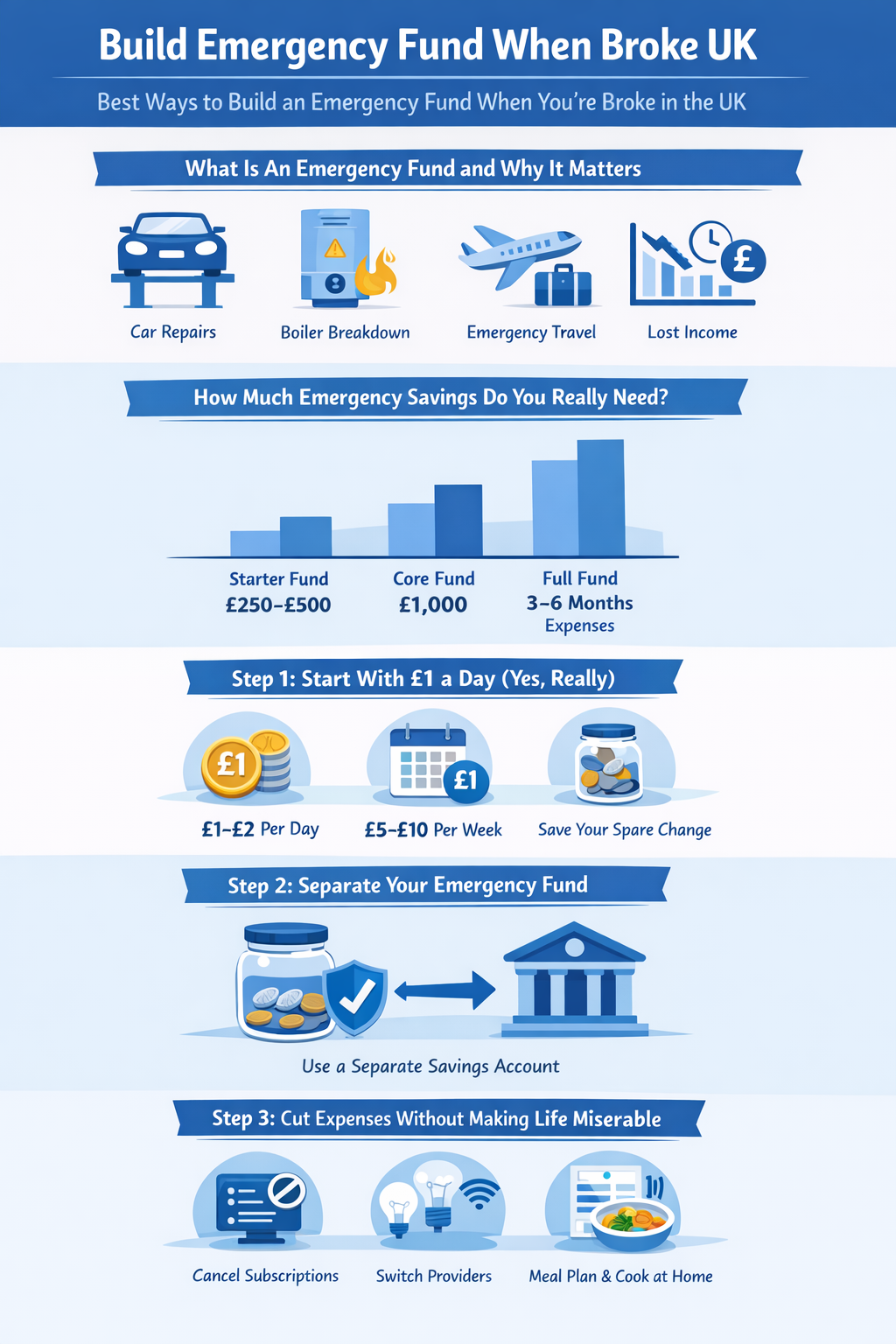
Visual summary of key points from 'How to Build an Emergency Fund When You're Broke in the UK (2026)'
Essential UK Budgeting & Personal Finance Guides for 2026
Discover practical tips, tools, and strategies to manage your money, save effectively, and stay on top of your finances.
Check out our key articles: How to Create a Simple Budget, How to Save £500 in 3 Months, Understanding Credit Scores in the UK.
How to Build an Emergency Fund When You're Broke in the UK (2026)
Most emergency fund advice assumes you have spare money sitting around. If you're living paycheque to paycheque, dealing with rising bills, or carrying debt, the standard "save three to six months of expenses" advice can feel so out of reach that it puts people off starting entirely.
This guide takes a different approach. It is specifically for people with very little or nothing to spare — and it focuses on the smallest realistic steps that still make a genuine difference to financial resilience.
Why even a tiny emergency fund matters
Without any savings buffer, a single unexpected cost — a car repair, a broken appliance, an emergency dental appointment — becomes a debt problem. You reach for a credit card, an overdraft, or a buy-now-pay-later service, and suddenly a £200 problem becomes a £240 problem with interest running on top.
Even £300 changes this dynamic. It is not financial security in any meaningful long-term sense, but it is enough to handle the most common household emergencies without adding to your debt. That is the only goal at the start — building a small enough buffer that bad luck stops automatically making your finances worse.
Build in stages — forget the full target for now
If the standard three-to-six months target feels paralysing, ignore it for now. Build in three stages and only focus on the one you're in:
| Stage | Target | What it covers | Focus when... |
|---|---|---|---|
| Starter | £300–£500 | Minor emergencies — car repair, appliance breakdown, urgent bill | You have very little or nothing saved |
| Core | £1,000 | Larger repairs, short income gap, urgent travel | Starter fund is complete and high-interest debt is cleared |
| Full | 3–6 months of essential expenses | Job loss, long-term illness, major financial disruption | Core fund is complete and finances are stable |
When you're broke, Stage 1 is the only thing that matters. Reaching £300–£500 is a real achievement and a genuine turning point in financial stability.
Step 1 — Find £5 to £20 a week without cutting everything
The first task is finding a small amount you can consistently set aside without making life miserable. For most people in tight financial situations, this means looking for cuts that have low day-to-day impact rather than big dramatic changes.
High-impact, low-pain places to find £5–£20 a week:
- Unused subscriptions — check your bank statement for anything that auto-renews and that you haven't actively used in the last month. Cancel it immediately and redirect the money. Even one cancelled subscription at £7–£15/month makes a difference.
- Mobile phone plan — if you are out of contract, switching to a SIM-only plan can save £10–£25 a month instantly. giffgaff, SMARTY, and Lebara offer plans from £6–£15/month with decent data.
- Broadband — if your minimum contract term has ended, you are almost certainly paying a loyalty penalty. Call your provider and threaten to leave — most will offer a reduced rate rather than lose you.
- Grocery swaps — switching two or three branded items per shop to own-brand equivalents typically saves £5–£15 per shop without noticeably affecting meals.
- Round-ups — apps like Monzo, Starling, and Chase UK offer round-up features that sweep the spare change from every transaction into a savings pot. Painless and genuinely adds up — typically £10–£25/month for average spenders.
You do not need all of these. One or two changes that free up £10–£20/month is enough to get started.
Step 2 — Open a separate account and name it
Do not keep your emergency fund in your current account. The moment it sits alongside your spending money, it will gradually get spent without you fully registering it.
Open a separate easy-access savings account — most UK banks and challenger banks allow this for free, and many let you name the pot ("Emergency Fund" or "Safety Net"). Seeing a named pot with a growing balance is consistently more motivating than a single account with a combined balance.
Good free options for a separate savings pot in the UK:
- Monzo savings pot (accessible via the app, earns interest)
- Starling savings space (same structure)
- Chase UK savings account (competitive easy-access rate)
- A basic easy-access savings account from any high street bank
For current easy-access rates, see our guide to best high-interest savings accounts in the UK — even on a small balance, earning 4–5% rather than 0% adds up over time.
Step 3 — Automate the transfer on payday
Set up a standing order to move whatever amount you've identified — even £5 or £10 — into your emergency fund on the day you get paid. Before rent, before food shopping, before anything else.
This is the single most important mechanical change you can make. When saving is automatic, it happens. When it depends on remembering to transfer whatever is left at the end of the month, it almost never happens because there is almost never anything left.
Start with an amount so small it feels almost pointless. £5 a week is £260 a year. £10 a week is £520. Neither feels like much per transfer — but both get you to a meaningful starter fund within 12 months without requiring any willpower after the initial setup.
Step 4 — Use windfalls and found money aggressively
When you're in a tight financial position, windfalls are your most powerful tool for accelerating the emergency fund — because they don't require you to change your day-to-day behaviour.
Treat the following as emergency fund contributions rather than spending money:
- Tax refunds — HMRC issues tax refunds when you've overpaid, often after changing jobs or claiming allowable expenses. Check your tax code is correct and claim anything owed.
- Cashback — TopCashback and Quidco pay out on purchases you were making anyway. Transfer cashback directly to your emergency fund when it arrives.
- Benefits and entitlements — many UK households are not claiming everything they're entitled to. Check eligibility for Council Tax Reduction, Universal Credit, Free School Meals, Healthy Start vouchers, and the Household Support Fund via your local council. Gov.uk's benefits calculator is a free starting point.
- Selling unused items — Facebook Marketplace, Vinted, and eBay can convert unused clothes, electronics, and household items into emergency fund cash. A single clearout often generates £50–£150.
- Refunds and overpayments — check for energy bill refunds if you've been in credit, council tax overpayments, and any insurance refunds owed.
Step 5 — Handle setbacks without giving up
The most common reason people fail to build an emergency fund when broke is not lack of effort — it is giving up after the fund gets used. You save £200 over three months, the car breaks down, and the fund goes back to zero. It feels like failure.
It is not failure. It is the fund doing exactly what it was built to do. The car repair happened without new debt. That is the win.
When the fund gets used, treat rebuilding it as the immediate next priority. Resume the standing order, redirect the next windfall, and accept that the process is not linear. Most people build and rebuild their starter fund two or three times before it stays intact long enough to grow to the core fund level.
What if there is genuinely nothing to spare?
If after reviewing all expenses there is truly nothing left, the problem may be income rather than spending — and no amount of budgeting fixes an income that does not cover essentials.
In that situation, the priority shifts to entitlements and support:
- Check benefit entitlements via the entitledto calculator or gov.uk benefits calculator
- Contact your local council about the Household Support Fund — it provides direct financial assistance for essentials
- Speak to your energy provider about hardship tariffs and the Warm Home Discount
- Contact Citizens Advice for free help navigating financial hardship
Saving is not the right first step when income does not cover basics. Getting entitled support in place comes first.
Frequently asked questions
- Should I build an emergency fund or pay off debt first? Do both simultaneously at the start — build a small £300–£500 starter fund while making minimum payments on all debts. Once the starter fund is in place, focus on clearing high-interest debt aggressively. The starter fund prevents you from adding new debt when something unexpected happens, which is why it comes before aggressive debt repayment rather than after.
- Where is the safest place to keep an emergency fund in the UK? An easy-access savings account with an FCA-regulated UK bank. Your money is protected up to £85,000 by the Financial Services Compensation Scheme (FSCS). Do not invest it — investments can fall in value and you need the money to be worth its full amount when you need it.
- How long will it take to save £500 from nothing? At £10/week it takes 50 weeks — just under a year. At £20/week it takes 25 weeks. At £40/month it takes just over a year. The exact timeline matters less than starting and maintaining the habit.
- Is it worth saving if I'm in debt? Yes — specifically a small starter fund of £300–£500. Without any buffer, every unexpected expense adds to your debt. With even a small fund in place, you handle emergencies without borrowing, which stops the debt growing further.
- What counts as an emergency when you have very little saved? When your fund is small (under £500), use it only for things that would otherwise force you into debt: essential car or home repairs, unexpected medical costs, or covering essential bills during a short income gap. Do not use it for anything that could wait or be planned for.