Best ISAs for UK Savers in 2026
 By Matthew Harman — Matthew has been navigating UK personal finance for over 30 years, from first mortgages to ISA strategies, and founded BudgetSense to share what actually works.
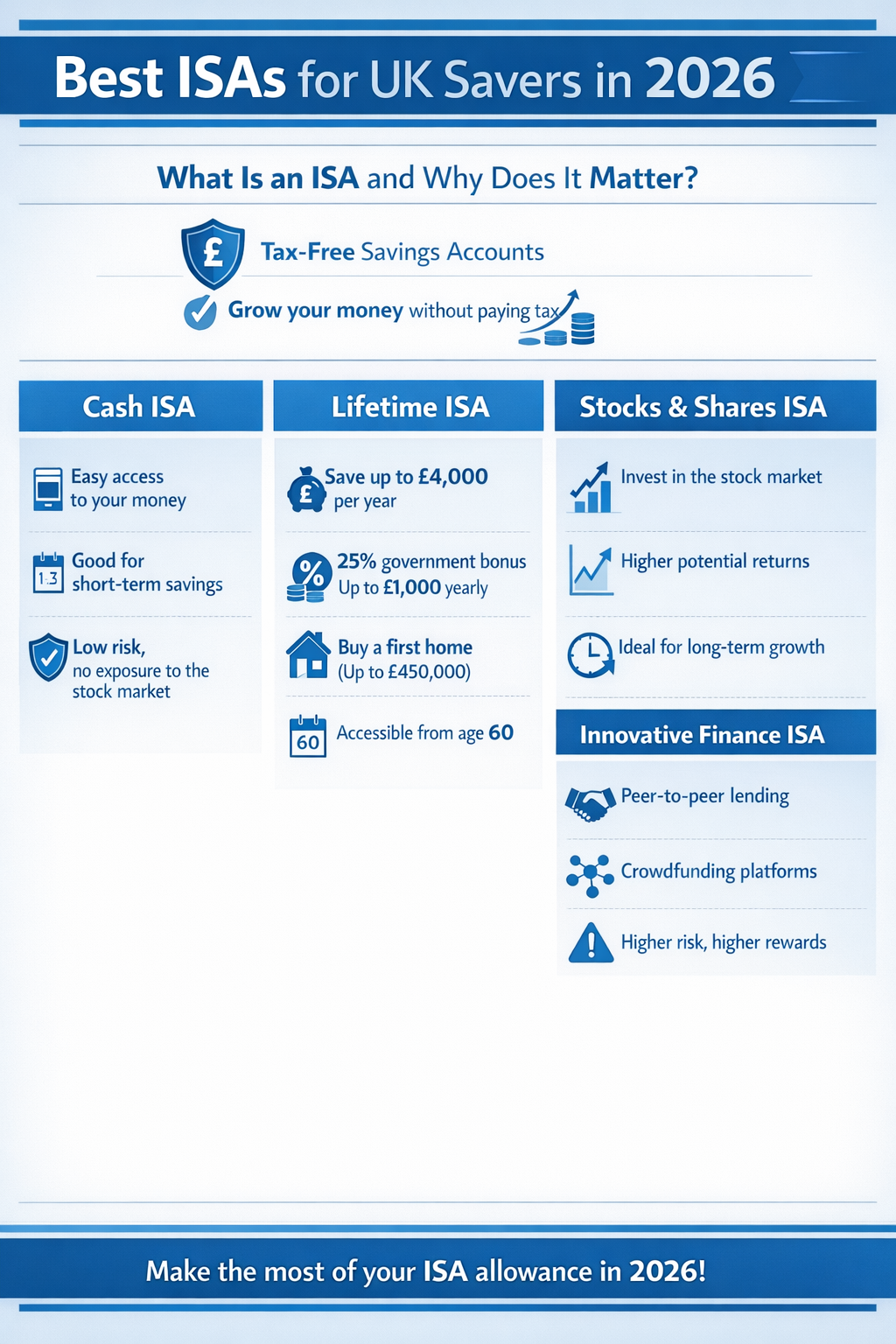
Visual summary of key points from 'Best ISAs for UK Savers in 2026 | BudgetSense'
Essential UK Budgeting & Personal Finance Guides for 2026
Discover practical tips, tools, and strategies to manage your money, save effectively, and stay on top of your finances.
Check out our key articles: How to Create a Simple Budget, How to Save £500 in 3 Months, Understanding Credit Scores in the UK.
Best ISAs for UK Savers in 2026
If you've ever Googled "ISA" and come away more confused than when you started, you're not alone. Between cash ISAs, stocks and shares ISAs, Lifetime ISAs, and Innovative Finance ISAs, the options can feel overwhelming — especially if you're just getting started with saving.
The good news is that ISAs are actually one of the simplest and most generous things the UK tax system offers ordinary savers. Once you understand what each type does, choosing the best ISA for a first-time saver in the UK in 2026 becomes much more straightforward.
I've been helping people navigate ISAs for decades, and in this guide I'll cut through the jargon and explain exactly which ISA is likely to suit you — depending on what you're saving for and how long you're saving for it.
What Is an ISA and Why Does It Matter?
An ISA — Individual Savings Account — is simply a tax-efficient wrapper around your savings or investments. Any interest, dividends, or growth you earn inside an ISA is completely free from UK income tax and Capital Gains Tax. You don't even need to declare it on a tax return.
In the 2025/26 tax year, every UK adult can save up to £20,000 across their ISAs. That allowance resets on 6th April each year — and you can't carry unused allowance forward, so it's worth using what you can.
For most first-time savers, the choice comes down to two or three main types. Let's go through each one.
Cash ISA
A cash ISA works exactly like a standard savings account, except the interest you earn is completely tax-free. You deposit money, it earns interest, and you pay nothing to HMRC on the returns.
Cash ISA rates in 2026 have remained competitive following the period of higher interest rates seen in recent years. Rates vary significantly between providers, so it pays to shop around — the difference between a top-rate cash ISA and a poor one can run to hundreds of pounds annually on a decent-sized balance.
A cash ISA is a good fit if:
- You want easy or instant access to your money
- You're saving for something within the next one to three years
- You're risk-averse and don't want exposure to stock market movements
- You already use your Personal Savings Allowance elsewhere
Fixed-rate cash ISAs typically offer higher interest than easy-access versions, but lock your money away for a set period — usually one to three years. If you're confident you won't need the money in that time, a fixed rate is usually worth considering.
Where to look: building societies, challenger banks, and comparison tools like MoneyHelper or MoneySavingExpert regularly highlight the best cash ISA rates currently available.
Lifetime ISA
The Lifetime ISA — or LISA — is, in my view, the most powerful savings account available to eligible UK savers right now. If you're between 18 and 39 and saving for your first home or retirement, it should be the first account you open.
Here's what makes it so valuable:
- Save up to £4,000 per year
- The government adds a 25% bonus — up to £1,000 every year
- Use it tax-free for a first home purchase (property must be £450,000 or under) or from age 60 onwards
- Available as a cash LISA or a stocks and shares LISA
That 25% bonus is genuinely remarkable. On £4,000 saved, you immediately have £5,000. No investment return in the world offers that kind of guaranteed uplift.
The important caveats: withdrawing for any other reason before age 60 incurs a 25% withdrawal charge, which effectively wipes out your bonus and clips a small amount of your own savings. So it's not the right account for money you might need in an emergency. Keep a separate easy-access fund for that.
Providers worth comparing for a Lifetime ISA include Moneybox, Nutmeg, and a handful of building societies. If you're also saving towards a house deposit, my guide on How to Save for a House Deposit on One Salary UK explains exactly how to make a LISA work as part of a broader deposit plan.
Stocks and Shares ISA
A stocks and shares ISA lets you invest in funds, shares, bonds, and other assets — all sheltered from tax. Over the long term, investing in the stock market has historically produced better returns than cash savings, though it comes with the important caveat that the value of investments can go down as well as up.
A stocks and shares ISA is generally better suited to savers with a time horizon of at least five years, where there's enough time to ride out any market dips. It's not the right choice for money you're planning to use in the next year or two.
For first-time investors, low-cost index funds — which track the performance of a broad market rather than trying to beat it — are widely recommended by independent financial guidance bodies including MoneyHelper and the FCA as a sensible starting point. They spread risk, keep charges low, and don't require you to pick individual stocks.
A stocks and shares ISA is worth considering if:
- You're saving for a goal five or more years away
- You want your money to potentially grow faster than inflation over time
- You're comfortable with the idea that the value may fluctuate in the short term
Popular providers include Vanguard, Hargreaves Lansdown, and AJ Bell. Charges vary, so always check the annual platform fee and fund costs before opening an account.
Innovative Finance ISA
An Innovative Finance ISA (IFISA) allows you to lend money through peer-to-peer lending platforms within a tax-free wrapper. Returns can be higher than cash ISAs, but the risks are considerably greater — your money is not protected by the Financial Services Compensation Scheme (FSCS) in the same way as a cash ISA.
For most first-time savers, I'd suggest getting comfortable with cash and stocks and shares ISAs before exploring this option. It's not one I'd recommend as a starting point.
Which ISA Is Right for You?
The honest answer depends on what you're saving for and when you'll need the money. Here's a simple way to think about it:
| Your Situation | Best ISA to Consider |
|---|---|
| Saving for a first home, aged 18–39 | Lifetime ISA (+ cash ISA for overflow) |
| Saving for something in 1–3 years | Cash ISA (easy access or fixed rate) |
| Saving for retirement or 5+ years away | Stocks and shares ISA (or Lifetime ISA) |
| Saving more than £4,000 towards a home | Lifetime ISA + cash ISA together |
| Not sure yet — just want to start | Easy-access cash ISA to begin |
You can hold multiple ISAs at the same time — for example, a Lifetime ISA and a cash ISA together — as long as your total contributions across all ISAs don't exceed the £20,000 annual allowance.
Practical Tips for Getting the Most From Your ISA
- Open your ISA early in the tax year so your money earns interest or grows for longer
- Set up a standing order into your ISA on payday — automation removes the temptation to spend first and save later
- Review your ISA rate annually; providers sometimes reduce rates on existing accounts while offering better rates to new customers
- Don't let unused allowance lapse at the end of the tax year — once 5th April passes, that year's allowance is gone forever
- Keep the FSCS protection limit in mind — cash held with FSCS-protected providers is covered up to £85,000 per institution
For more on building consistent saving habits around your ISA contributions, read my guide on How to Save Money Consistently on a UK Budget.
Frequently Asked Questions
What is the best ISA for a first-time saver in the UK in 2026?
For most first-time savers, the best starting point depends on your goal. If you're saving for a first home and aged between 18 and 39, a Lifetime ISA offers an unbeatable 25% government bonus on contributions up to £4,000 per year. If you simply want a safe, tax-free home for your savings with easy access, a competitive cash ISA is the most straightforward option. Many savers use both simultaneously to maximise their allowance.
What are the best cash ISA rates in 2026?
Cash ISA rates have remained relatively competitive in 2026 following the higher interest rate environment of recent years. Rates vary significantly between providers, so it's worth checking comparison tools such as MoneyHelper or MoneySavingExpert regularly for the most up-to-date figures. Fixed-rate cash ISAs typically offer higher returns than easy-access accounts in exchange for locking your money away for a set term.
Is a Lifetime ISA worth it in 2026?
For eligible savers — those aged 18 to 39 buying their first home or saving for retirement — a Lifetime ISA remains one of the best savings products available in the UK. The 25% government bonus, worth up to £1,000 per year, is effectively a guaranteed return on your contributions that no savings account or investment can match from day one. The main restriction to understand is that withdrawing early for any other purpose incurs a penalty charge, so it should sit alongside — not replace — a separate accessible emergency fund.
Final Thoughts
ISAs are one of the few genuine gifts the UK tax system offers ordinary savers, and in 2026 the options available are better than ever. Whether you're just starting out, saving for your first home, or thinking further ahead, there's an ISA designed to work for your situation.
The most important thing is simply to start. Open an account, set up a regular contribution, and let time and tax-free growth do the work. If you're saving towards a first home specifically, read my full guide on How to Save for a House Deposit on One Salary UK for a complete plan built around exactly that goal.